
Effects of Spatiotemporal Parameters on Forearm Vibrotactile Stimulus Identification
Abstract
Touch provides a direct and private channel for transmitting information through the skin, offering a foundation for wearable tactile communication. This study examines how spatial and temporal parameters jointly determine the perceptual identifiability and information transfer of vibrotactile stimuli on the forearm. In six experiments, we characterize the effects of actuator density, vibration duration, inter-stimulus interval, and sequence length using multi-actuator arrays. Results showed that localization remained reliable up to four tactors per forearm band but deteriorated with higher spatial density. Shorter vibration durations around 0.5 s preserved accuracy while improving temporal efficiency, and an inter-stimulus interval around 0.5 s effectively reduced sequential interference. These findings delineate how spatial layout and temporal timing influence identifiability and information transfer on the forearm, and inform the design of compact, efficient wearable tactile displays.
Key Contributions
- 1
First comprehensive 6-experiment study jointly examining spatial and temporal parameters for forearm vibrotactile identification, filling a critical gap in the tactile communication literature
- 2
Established that up to 4 tactors per forearm band enables reliable localization (>95% accuracy), while performance degrades sharply beyond this density
- 3
Demonstrated that 3–4 arm bands distribute tactors effectively, improving accuracy from 85% to 93% (IT 3.1–3.2 bits) compared to 2-band layouts
- 4
Showed that 0.5 s vibration duration preserves single-stimulus accuracy while quadrupling temporal efficiency versus 2 s
- 5
Identified 0.5 s ISI as the practical optimum for sequential stimulation, effectively mitigating interference without requiring longer gaps
Experimental Apparatus
ERM (Eccentric Rotating Mass) motors were used as vibrotactile actuators, driven by PWM signals from an Arduino Due. Tactors were mounted on adjustable velcro bands and positioned along the distal–proximal forearm axis, distributed across palmar, dorsal, medial, and lateral surfaces.
6
Experiments
3 spatial + 3 temporal
10/exp
Participants
60 total across all experiments
ERM
Actuator Type
160 Hz, 1 G peak acceleration
PC + IT
Metrics
Percent-correct & Information Transfer
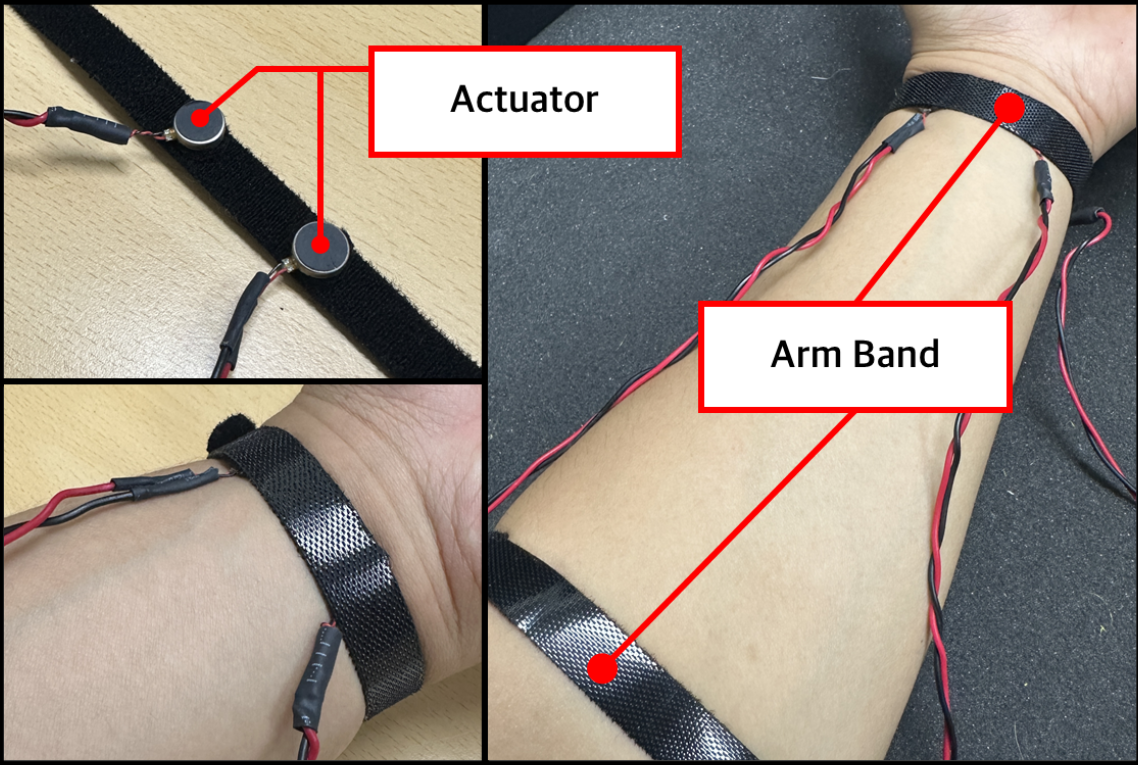
Fig. 1. Example placement of tactors on the distal and proximal forearm using velcro bands.
Exp. 1–3: Effects of Spatial Factors
Three experiments systematically varied the number and arrangement of tactors to establish the spatial limits of forearm vibrotactile localization.
N = 10 participants · Spatial
Examined localization with 2–4 tactors per band across distal and proximal forearm bands. Performance remained consistently above 95% for all layouts.
N = 10 participants · Spatial
Progressively increased tactor count from 8 to 12 within two-band configurations. Accuracy declined significantly beyond 8 tactors.
N = 10 participants · Spatial
Distributed tactors across 3–5 arm bands. The 12-tactor multi-band layouts achieved 85–93%, outperforming 2-band equivalents.
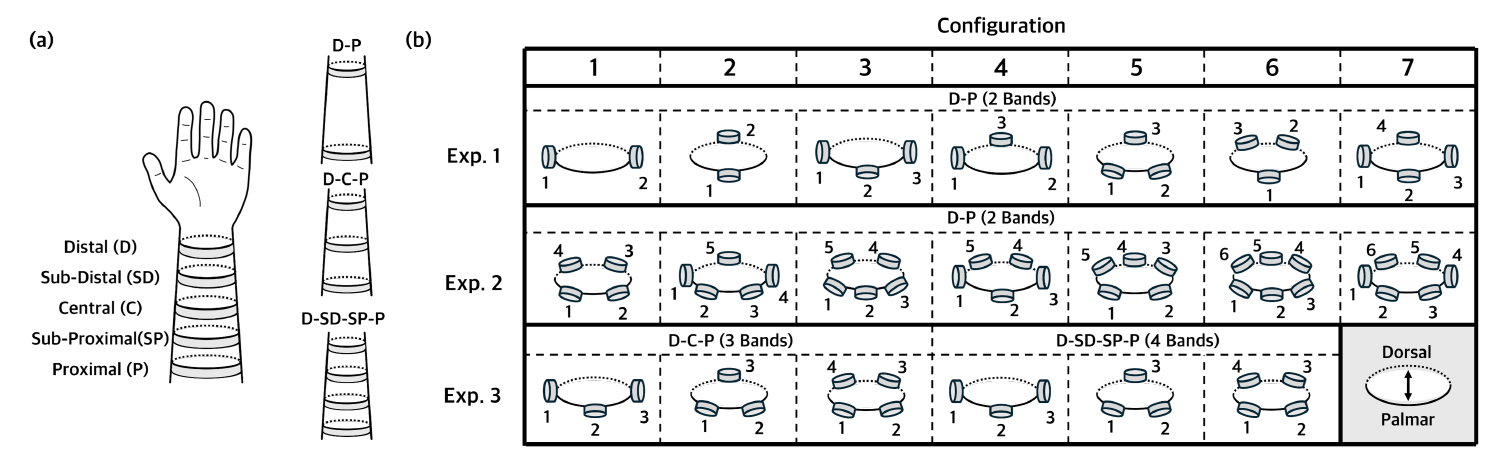
Fig. 2. Spatial configurations used in Exp. 1–3.
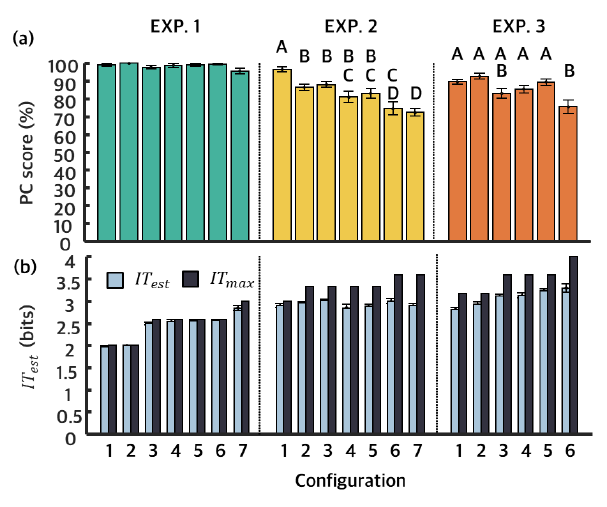
Fig. 4. PC scores and IT values across all spatial configurations in Exp. 1–3.
Exp. 4–6: Effects of Temporal Factors
Using the optimal spatial configurations from Exp. 1–3, three further experiments examined vibration duration, inter-stimulus interval, and sequence length.
N = 10 participants · Temporal
Compared 1.0 s and 0.5 s vibrations on the best spatial configurations from Exp 3. Duration showed no significant main effect on single-stimulus identification.
N = 10 participants · Temporal
Tested two consecutive vibrations with ISIs of 0, 0.5, and 1.0 s. Full-sequence accuracy improved from 44.0% at 0 s to 50.6% at 0.5 s, with no further gain at 1.0 s.
N = 10 participants · Temporal
Extended to 2- and 3-vibration sequences with 9 tactors. Longer sequences showed greater sensitivity to ISI; 3-vibration accuracy improved from 46.8% to 55.1% with 0.5 s vs 0.3 s ISI.
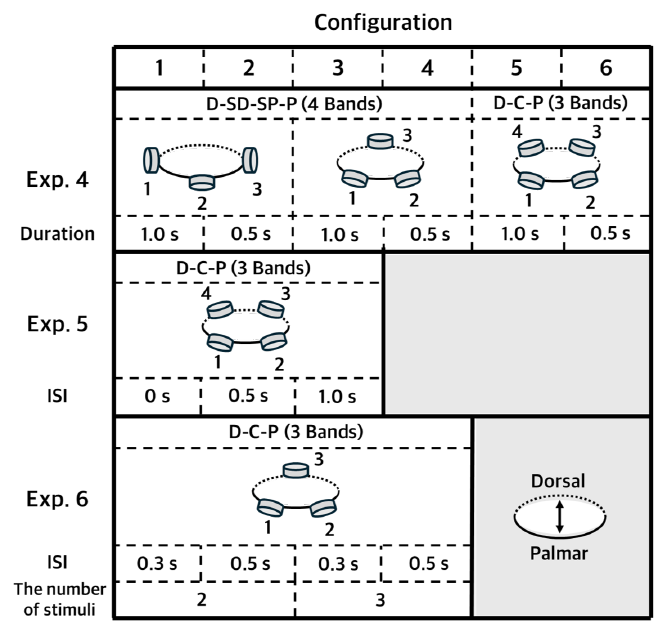
Fig. 9. Spatiotemporal conditions used in Exp. 4–6 with cross-sectional tactor layouts.
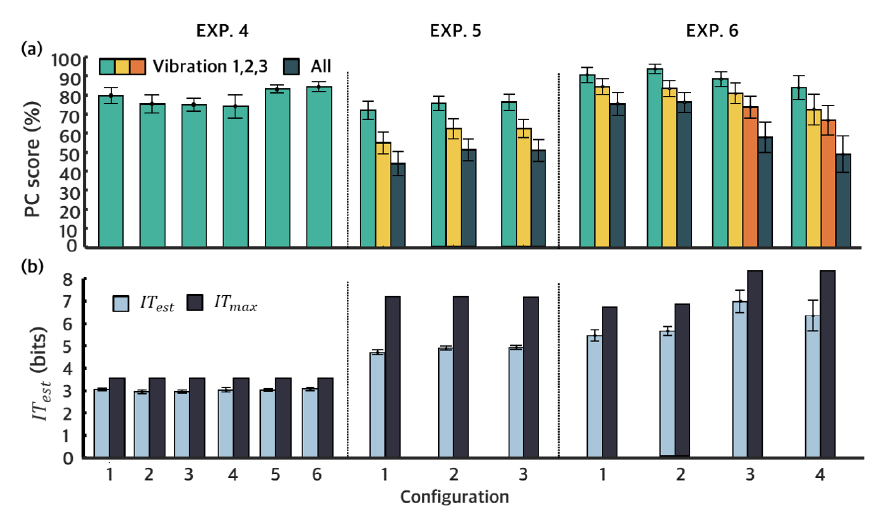
Fig. 11. PC scores for temporal experiments. Sequential stimuli accuracy by vibration number and ISI.
Design Guidelines for Wearable Tactile Displays
Based on the six experiments, these guidelines inform the design of compact, efficient forearm-mounted vibrotactile displays for tactile communication.
Limit to 4 tactors per band
Localization remains reliable up to 4 tactors per arm band. Beyond this, spatial interference sharply reduces identifiability.
Use 3–4 arm bands
Distributing tactors across 3–4 bands improves accuracy from ~73% to 87%, reducing intra-band confusion without excessive inter-band errors.
Use 0.5 s vibration duration
A 0.5 s duration preserves single-stimulus accuracy while enabling up to 4× higher information throughput compared to 2 s stimuli.
Apply 0.5 s ISI for sequences
A 0.5 s inter-stimulus interval effectively mitigates temporal masking. Longer intervals yield little additional benefit.
Reduce density for longer sequences
For multi-vibration sequences, reducing spatial density (e.g., 12 → 9 tactors) significantly improves both accuracy and information transfer.
Prefer distal/proximal locations
Tactors at the distal and proximal ends of the forearm consistently support more reliable identification than intermediate regions.
Citation
@inproceedings{kim2026spatiotemporal,
  title     = {Effects of Spatiotemporal Parameters on Forearm
               Vibrotactile Stimulus Identification},
  author    = {Kim, Dong-Geun and Lee, Geunho and Nam, Suheon
               and Park, Chaeyong and Choi, Seungmoon},
  booktitle = {Proceedings of the IEEE Haptics Symposium 2026},
  year      = {2026}
}
This work was supported by the Korean government (MSIT) through NST (CRC23021-000) and IITP (IITP-2026-RS-2024-00437866; IITP-RS-2025-02214780).