
Effects of Haptic Feedback on Gaming Experiences: A Case Study Comparing Players and Spectators in FPS Games
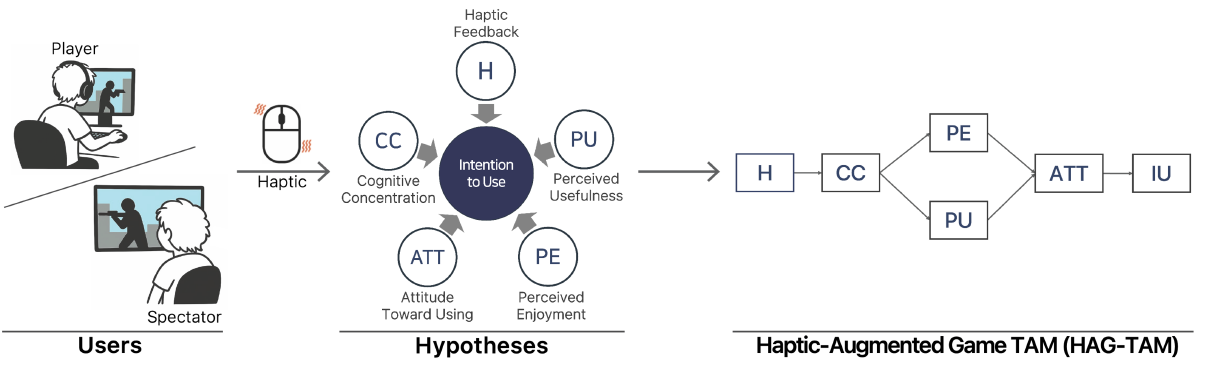
Research overview: users play or spectate an FPS game with haptic feedback, modeled through the HAG-TAM framework.
Abstract
Haptic feedback has become a common feature in game experiences, yet little is known about how its effects differ between active players and passive spectators. This study investigated how haptic feedback influences user experience and technology acceptance in the context of first-person shooter (FPS) games, particularly by comparing its effects on active players and passive spectators. An experiment with 60 participants tested four conditions defined by two factors: haptic feedback (present vs. absent) and user role (player vs. spectator). The results showed that haptic feedback enhanced the intention to use games in both roles, with a stronger effect among spectators. Players' intention was primarily driven by perceived enjoyment through a hedonic pathway, whereas spectators responded to both perceived enjoyment and perceived usefulness through both hedonic and eudaimonic pathways.
Key Contributions
- 1
HAG-TAM (Haptic-Augmented Game Technology Acceptance Model): a novel 6-construct model tailored to evaluate haptic feedback in FPS gaming contexts
- 2
First systematic comparison of haptic feedback effects between active players and passive spectators, revealing distinct technology acceptance pathways
- 3
Identification of a hedonic pathway (dominant for players) and eudaimonic pathway (significant for spectators), informing role-sensitive haptic design
- 4
Empirical evidence that spectators are more strongly influenced by haptic feedback than players, challenging assumptions about haptics in passive entertainment
Study Design
A within-subject experiment with 60 participants (36M, 24F; ages 18–32) tested four conditions: Player vs. Spectator × Haptic vs. Non-Haptic. Participants used a custom haptic mouse (3 voice-coil actuators) in an FPS game powered by Aimlabs, with audio-to-haptic conversion for gunshot and footstep events.
60
Participants
36M, 24F
4
Conditions
Role × Haptic
3
Voice-coil Actuators
Custom haptic mouse
7-pt
Likert Scale
14 questionnaire items
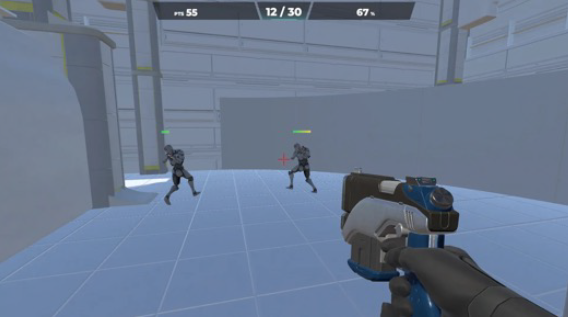
Fig. 5. Custom FPS game (Aimlabs) used in the user study.
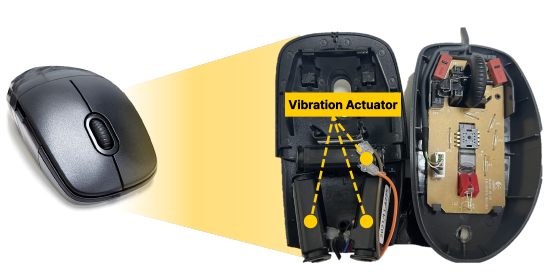
Fig. 6. Custom haptic mouse with 3 embedded voice-coil actuators.
HAG-TAM: Research Model
The Haptic-Augmented Game Technology Acceptance Model (HAG-TAM) extends the classic TAM with haptic feedback as an exogenous variable, and adds cognitive concentration and perceived enjoyment as hedonic constructs central to gaming contexts.
H
Haptic Feedback
Presence or absence of tactile stimuli during gameplay
CC
Cognitive Concentration
Extent to which the user's attention is absorbed in the game
PE
Perceived Enjoyment
Degree to which playing/spectating is perceived as enjoyable
PU
Perceived Usefulness
Degree to which the game is perceived to improve quality of life
ATT
Attitude Toward Using
Overall affective evaluation about engaging with the game
IU
Intention to Use
Behavioral plan or desire to use the technology in the future
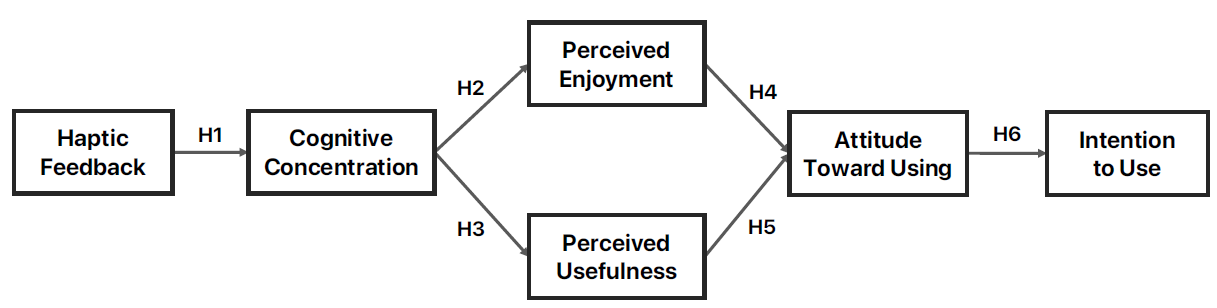
Fig. 3. HAG-TAM with 6 constructs and 6 hypothesized causal relationships (H1–H6).
Results
All six hypotheses were supported for both players and spectators (p < .001). The structural model revealed two distinct pathways and notable role-dependent differences.
Construct Means by Condition
Haptic feedback consistently raised all five constructs for both players and spectators. The effect was more pronounced among spectators across all measures, with the largest gap observed in cognitive concentration and intention to use.
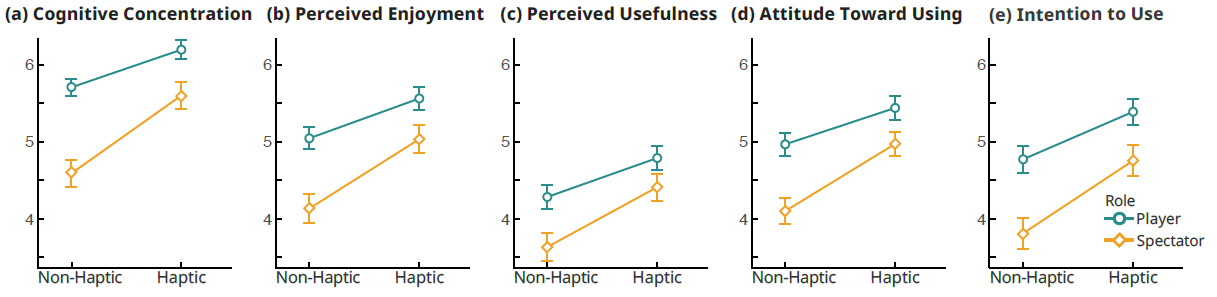
Fig. 8. Means and standard errors of (a) Cognitive Concentration, (b) Perceived Enjoyment, (c) Perceived Usefulness, (d) Attitude Toward Using, and (e) Intention to Use across the four conditions.
Mean Scores by Condition (7-point scale)
| Condition | CC | PE | PU | ATT | IU |
|---|---|---|---|---|---|
| Player + Haptic | 6.19 | 5.56 | 4.79 | 5.44 | 5.39 |
| Player + No Haptic | 5.71 | 5.04 | 4.28 | 4.97 | 4.77 |
| Spectator + Haptic | 5.60 | 5.03 | 4.41 | 4.97 | 4.76 |
| Spectator + No Haptic | 4.59 | 4.13 | 3.63 | 4.10 | 3.81 |
CC: Cognitive Concentration, PE: Perceived Enjoyment, PU: Perceived Usefulness, ATT: Attitude Toward Using, IU: Intention to Use
HAG-TAM Path Coefficients (β)
| Hypothesis | Path | Player β | Spectator β | Note |
|---|---|---|---|---|
| H1 | H → CC | 0.511 | 0.793 | Stronger for spectators |
| H2 | CC → PE | 0.562 | 0.683 | Stronger for spectators |
| H3 | CC → PU | 0.466 | 0.519 | Similar across roles |
| H4 | PE → ATT | 0.607 | 0.529 | Stronger for players |
| H5 | PU → ATT | 0.334 | 0.446 | Stronger for spectators |
| H6 | ATT → IU | 0.871 | 0.924 | Very strong for both |
All paths statistically significant at p < .001 for both groups.
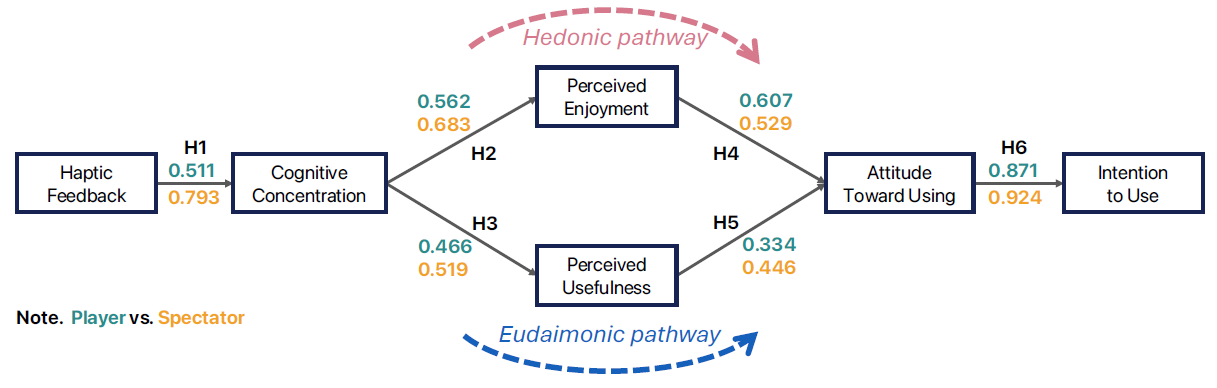
Fig. 9. Structural model results. Green: player path coefficients; Orange: spectator path coefficients. Hedonic pathway (top) and eudaimonic pathway (bottom).
Key Findings
Spectators benefit more from haptic feedback
Haptic feedback increased all constructs for both groups, but spectators showed significantly larger improvements — particularly in cognitive concentration (H1: β=0.793 vs 0.511).
Two distinct acceptance pathways
Players are driven primarily by the hedonic pathway (perceived enjoyment → attitude, β=0.607), while spectators are influenced by both hedonic and eudaimonic (perceived usefulness → attitude, β=0.446) pathways.
Game performance unaffected
Shooting accuracy and game score showed no statistically significant difference between haptic and non-haptic conditions, suggesting haptics enhance experience without compromising performance.
Attitude strongly predicts intention
The ATT → IU path was extremely strong for both players (β=0.871) and spectators (β=0.924), validating that positive attitudes translate directly to future use intentions.
Citation
@inproceedings{Sohn2026:effects,
  author    = {Sohn, Heeji and Park, Chaeyong and Choi, Seungmoon},
  title     = {Effects of Haptic Feedback on Gaming Experiences: A Case Study Comparing Players and Spectators in FPS Games},
  year      = {2026},
  isbn      = {9798400722783},
  publisher = {Association for Computing Machinery},
  address   = {New York, NY, USA},
  url       = {https://doi.org/10.1145/3772318.3791144},
  doi       = {10.1145/3772318.3791144},
  booktitle = {Proceedings of the 2026 CHI Conference on Human Factors in Computing Systems},
  articleno = {846},
  numpages  = {16},
  keywords  = {Video games, haptics, gaming experience, player, spectator, technology acceptance},
  series    = {CHI '26}
}
This research was partly supported by NST (CRC23021-000), NRF (2022R1A2C2091161), IITP (IITP-RS-2025-02214780), and ICT Creative Consilience Program (IITP-2026-RS-2020-II201819).