
HaRing: A Haptic Ring Interface for One-Handed Interaction with High-Dimensional Spatial Information
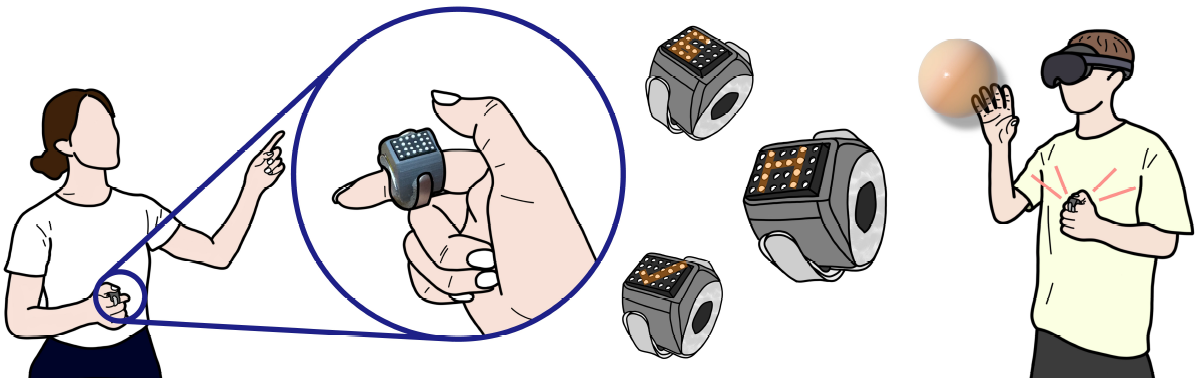
HaRing is worn on the index finger and explored with the thumb, enabling eyes-free, one-handed interaction.
Abstract
Ring interfaces have gained attention in wearable technology for their lightweight and hands-free design. However, their compact form factor limits them to conveying simple information through vibration, electrotactile, or force feedback. We introduce HaRing, a novel haptic ring interface equipped with a 4 × 6 pin array display. This dynamic display delivers rich spatial patterns that simple vibration cannot express, effectively conveying high-dimensional information such as directions, semantic symbols, and letters. Its design enables one-handed, eyes-free interaction that does not interfere with visual tasks. We conducted a series of perceptual and user studies demonstrating a high recognition accuracy of over 94% for complex letters after a brief training period.
Key Contributions
- 1
HaRing: a light, eyes-free, one-handed wearable tactile ring with a 4 × 6 pin array — the first ring-form high-resolution pin-array display
- 2
User-centered design methodology integrating empirical perceptual data to optimize haptic patterns for the pin-array form factor
- 3
Directional information conveyed with 98.3% accuracy without prior training (12 directions)
- 4
Alphabet recognition accuracy of 93.2% achieved with only ~32 minutes of short-term learning
HaRing Design
HaRing is worn on the index finger and features a 4 × 6 pin array (24 pins total) actuated by individual solenoids with a flip-latch mechanism. The display module measures just 10.1 × 15.6 × 8.15 mm, fitting the ring form factor while delivering high-resolution spatial patterns.
4 × 6
Pin Array
24 individually actuated pins
10.1 mm
Display Size
× 15.6 × 8.15 mm module
Directions, Letters, Symbols
Pattern Types
High-dimensional information
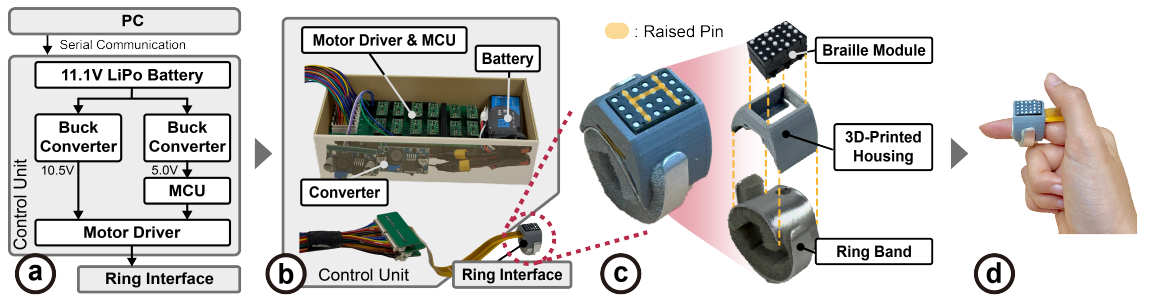
Fig. 2. System architecture, hardware, exploded view, and wearing example.
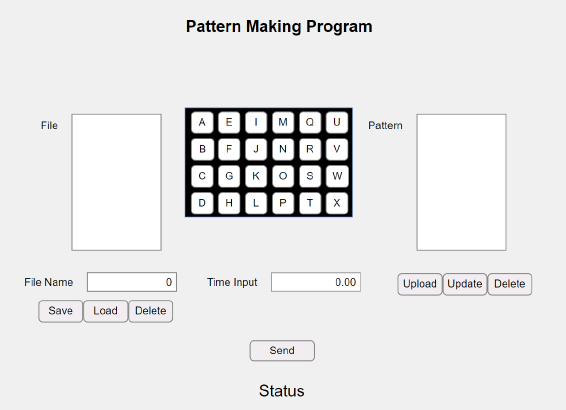
Fig. 3. GUI-based authoring tool for creating tactile patterns.
User Studies
Four sequential studies progressively validated HaRing's perceptual capabilities, from primitive pattern recognition to complex alphabet learning.
Evaluated fundamental haptic perception using dots (single-pin), lines, and 2D shapes on HaRing across three sessions with 10 participants.
78.5%
Dots accuracy
84.0%
Lines accuracy
69.6%
Shapes accuracy
10 participants designed haptic patterns for 24 keywords (12 semantic + 12 directional), iteratively creating and refining patterns using the HaRing authoring tool.
10
Participants
24
Keywords
240
Patterns collected
16 participants identified digits, alphabets, semantic keywords, and directional patterns. Intuitive user-designed patterns showed significantly higher accuracy than symbolic characters.
98.3%
Directions
81.1%
Semantic keywords
65.2%
Digits
55.2%
Alphabets
18 participants underwent a structured learning protocol (Exploration → Learning → Test). Participants who did not meet the 80% threshold on Day 1 (Group B) were retested within 4 days.
68.8%
Initial accuracy
93.2%
Final accuracy
~32 min
Training time
4.52 s
Response time
Designed Haptic Patterns (Exp. 2 Output)
10 participants iteratively designed patterns for 24 keywords using the HaRing authoring tool. The final patterns were selected by prioritizing user consensus, empirical perceptual data from Exp. 1, and expert refinement — balancing visual intuition with tactile distinguishability. Semantic patterns (left) include media controls, social actions, and confirmation symbols. Directional patterns (right) cover 8 cardinal directions and 4 navigation commands, designed using edge-based cues for clearer perceptual distinction.
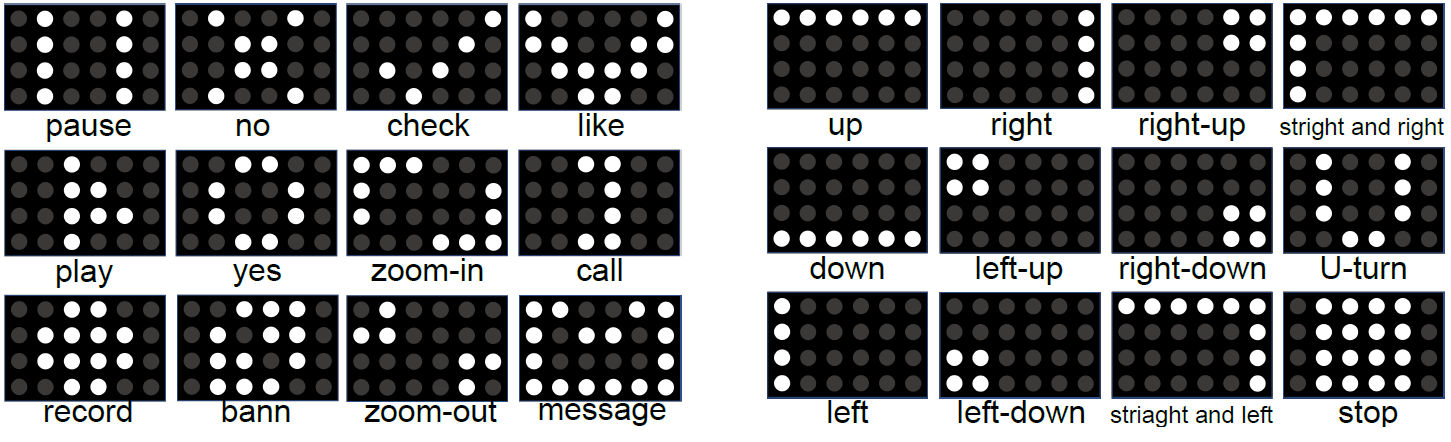
Fig. 7–8. Final haptic patterns designed for 12 semantic keywords (left) and 12 directional keywords (right).
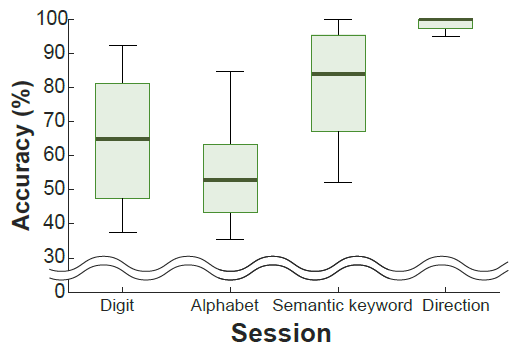
Fig. 12. Box plots for accuracy in Exp. 3: directions 98.3%, semantic 81.1%.
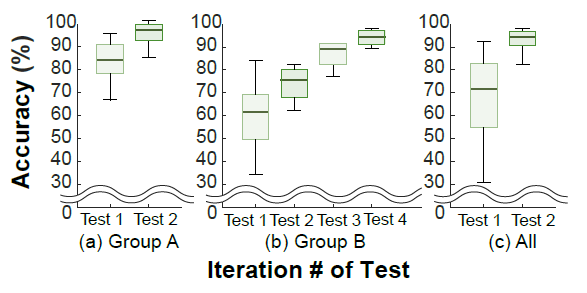
Fig. 13. Accuracy improved from 68.8% to 93.2% after short-term learning.
Application Scenarios
HaRing enables eyes-free, one-handed interaction across a variety of real-world and VR contexts where visual or auditory channels are occupied.
Eyes-Free Navigation
Convey complex directional cues (e.g., 'go straight and turn left') during walking or driving without visual distraction.
Tactile Feedforward in VR
As users hover over virtual menu items, HaRing renders the shape or label of each item directly on the fingertip.
Unobtrusive Communication
Privately receive messages or cues during meetings without retrieving a smartphone, keeping interactions seamless.
Remote Object Control
During high-focus tasks like UAV or robot teleoperation, HaRing delivers ambient information such as obstacle proximity.
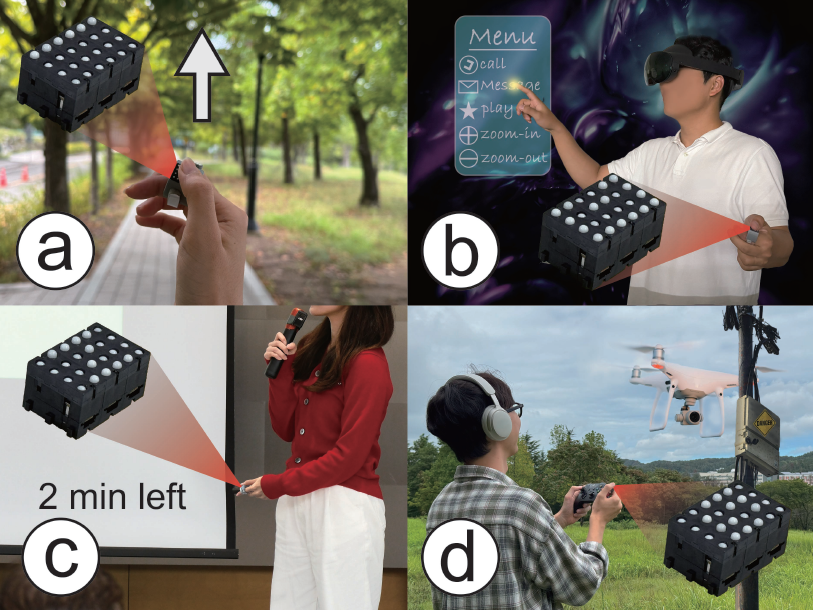
Fig. 15. Application scenarios: (a) eyes-free navigation, (b) VR menu selection, (c) unobtrusive information transfer, (d) remote object control.
Citation
@inproceedings{Nam2026:HaRing,
  author    = {Nam, Suheon and Son, Juhyung and Choi, Seungmoon and Park, Chaeyong},
  title     = {HaRing: A Haptic Ring Interface for One-Handed Interaction with High-Dimensional Spatial Information},
  year      = {2026},
  isbn      = {9798400722783},
  publisher = {Association for Computing Machinery},
  address   = {New York, NY, USA},
  url       = {https://doi.org/10.1145/3772318.3791663},
  doi       = {10.1145/3772318.3791663},
  booktitle = {Proceedings of the 2026 CHI Conference on Human Factors in Computing Systems},
  articleno = {1119},
  numpages  = {15},
  keywords  = {Wearable Tactile Display, Finger-Worn Tactile Display, Ring, One-hand interaction, Spatial Tactile Pattern, Eyes-Free Interaction},
  series    = {CHI '26}
}
This work was supported by ITRC (IITP-2026-RS-2024-00437866), NRF (RS-2024-00451947), NST (CRC23021-000), and ICT Creative Consilience Program (IITP-2026-RS-2020-II201819).